By, Deacon Stephanos Khoury, St. George Greek Catholic Church
Zababdeh, Jenin
What is happening today around Zababdeh is not simply a change to a road, and it is not simply an iron gate placed beside the road. What is happening is an attempt to turn our daily lives into a life of control and waiting.
The municipality of Zababdeh announced the confiscation of large areas of land surrounding the town. These are not empty pieces of land for us. They are lands where our families have lived, where our grandparents planted and worked, and where olive trees have grown carrying the memory of generations. When land is confiscated, it is not only a piece of soil that is taken. A part of people’s history and future is taken with it.
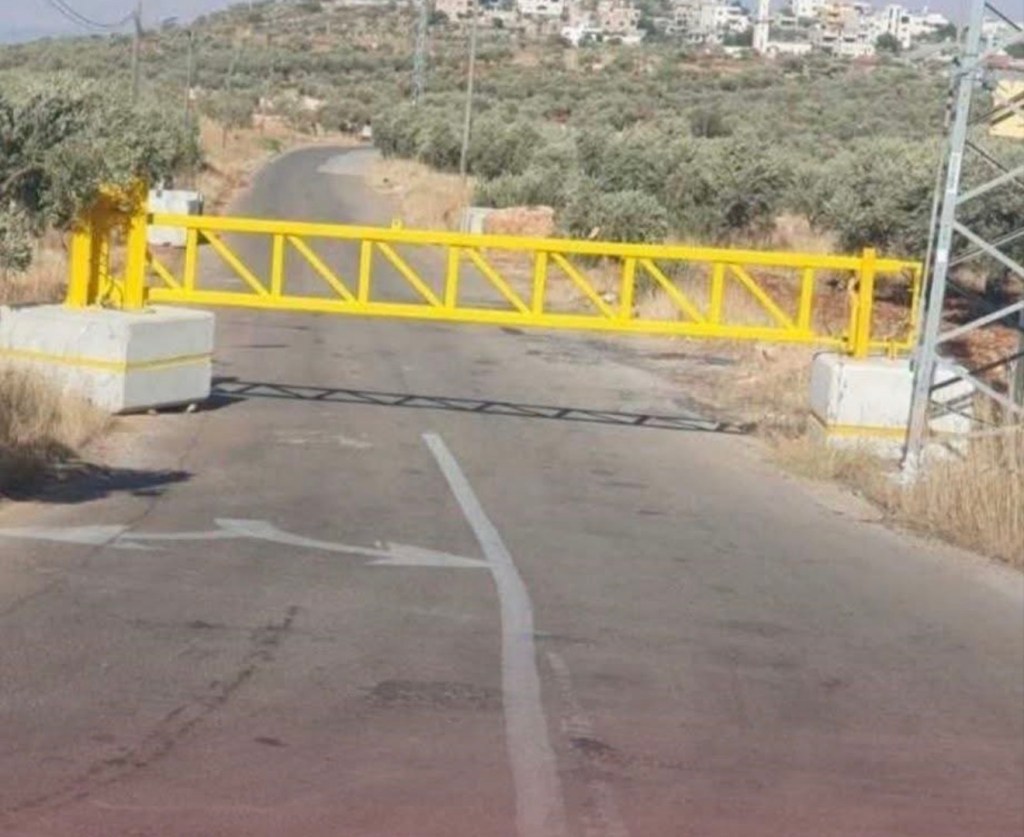
Now, near Zababdeh, a new iron gate has been installed by the occupation forces. To someone seeing it from far away, it may look like nothing more than a gate. But for us, it has become part of our daily lives. Its purpose is to control who can enter and leave the area and to regulate people’s movement according to specific hours, so that a person is no longer free to leave the town or return to it whenever they want. For farmers, this also means that access to their land can become dependent on a military decision and on the hours during which the gate is opened.
This is how small things begin to create a much larger reality: land is confiscated, a road is closed, and a gate is opened and shut according to military orders. After some time, people find themselves living in a smaller space, with less freedom of movement and greater fear.
But we refuse to allow this reality to become the end of our story. We are angry, yes, and we have the right to be angry when our land is confiscated and our access to it is restricted. But our anger will not become hatred, and it will not become violence. We want to turn our anger into faith, into service, into education, into holding on to the land, and into building a future for our children.
This is what I call “angry faith”: to see injustice and refuse to accept it as something normal. To cry out to God when I feel crushed, just as Jesus cried from the cross, “My God, my God, why have you forsaken me?” But, like Jesus, I will not allow my anger to become hatred.
They may confiscate our land, but they cannot confiscate our memory. They may put up gates, but they cannot put a gate in front of hope. They may control the hours of the road, but they cannot control our faith.
We believe that the cross is not the end, that the tomb is not the end, and that death did not have the final word. That is why, even as we live under pressure, fear, and restrictions, we try every day to keep hope alive.
The gate may be closed in front of us, but heaven cannot be closed. The land may be taken from our hands, but our roots cannot be uprooted. The road may be blocked, but our hope cannot be imprisoned.
We are still here in Zababdeh.
We pray. We serve. We teach our children. We plant wherever we can. And we continue to build Living Stones.
Our faith is angry. Our faith is wounded. But our faith is alive.
 The Living Stones Collective