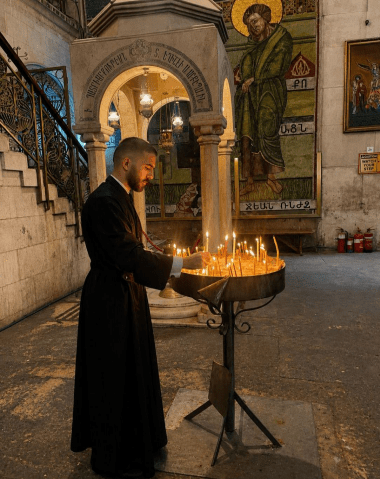
By, Deacon Stephanos Khoury, St. George Greek Catholic Church (above)
Zababdeh, Jenin
Thank you for your love for the living stones, and for your prayers that give us strength to continue through everything we are living. Today is Wednesday, and in our Eastern tradition we celebrate what we call the “Leave-taking of Easter.” It is the day on which we bid farewell to the liturgical season of the Resurrection, after more than forty days of hymns and prayers that filled the Church with the joy and light of the Resurrection. Yet it is not a farewell to life or hope, but rather a transition from outward celebration to carrying the Resurrection within our hearts and daily lives.
In our Eastern Churches, Easter remains present throughout all these weeks, as though the Church does not want to leave the empty tomb too quickly. The risen Christ is not experienced in only one moment; a person needs to walk with Him for a long time in order to understand the meaning of victory over death, fear, and despair. That is why every day we continue to proclaim: “Christ is risen from the dead, trampling down death by death, and upon those in the tombs bestowing life.” Over time, these words become more than a hymn; they become the breathing of the soul, medicine for weary hearts, and strength for those who live amid suffering and injustice. The Leave-taking of Easter carries very deep emotions in our tradition. There is a certain sadness because the season of Paschal hymns comes to an end, but there is also spiritual maturity, because the Church invites us not to cling only to beautiful emotions, but to carry the Resurrection with us into a wounded world. It is as though the Church is saying to us: now that you have seen the light of the Resurrection, go and bring this light to the tired and forgotten people of the world.
For us here, we understand the Resurrection somewhat differently, because we live every day close to the Cross. When a person hears the sounds of war and fear, and sees checkpoints, walls, tears, and exhaustion in the eyes of the people, the Resurrection becomes a true act of faith, not merely a celebration. We do not believe in a Resurrection separated from suffering, but in a Resurrection that emerged from the very heart of wounds. Christ Himself rose while still bearing the marks of the nails in His hands and side. Therefore, when we look at our own lives, we understand that wounds do not erase the presence of God; sometimes they become the very place where His glory and mercy are revealed.
During the leave-taking of Easter, I always remember the disciples after the Resurrection. They were afraid, uncertain, and did not know what awaited them, yet Christ entered through their closed doors and said to them, “Peace be with you.” This peace was not the absence of pain, but the presence of God within pain. And this is what we need today more than ever. People here are not searching only for political words or analysis; they are searching for inner peace, for someone who listens to them, and for hope that tells them God has not abandoned them.
Sometimes I think that the living stones in this land resemble the Church of the Resurrection itself. The outer stones may appear old, tired, and cracked, but inside there is the light of the Resurrection that never goes out. Such is our people. Our lives may seem filled with exhaustion and brokenness, yet there is still a living faith sustaining the people and helping them rise every morning despite everything. On this day we also remember that after the Resurrection, Christ did not remain in the tomb, but walked among the people, ate with them, and listened to their fears and questions. He walked with the sorrowful disciples on the road to Emmaus before opening their eyes. This gives us great consolation, because God does not leave a person alone on the journey.
Even when we do not understand what is happening around us, and even when the road appears dark, Christ still walks beside us in silence until the moment our eyes are opened and we realize He has been with us from the very beginning. The Leave-taking of Easter also teaches us that faith is not a short season, but a way of life. A true Christian does not live the Resurrection only inside the church, but carries it into the home, the workplace, relationships, and daily suffering.
The Resurrection means refusing to allow hatred to triumph over us, refusing to let fear destroy our humanity, and refusing to let despair steal our future.
The Resurrection means believing that God is always able to create a new beginning even from the midst of ruin.
Today, as we bid farewell to the season of Easter, we pray that the light of the Resurrection may remain alive within us. We pray for every person who has lost hope, for exhausted families, for young people searching for a future, and for the sick, the hungry, and the fearful. We pray that God may give us the strength to remain witnesses of love in a world filled with cruelty. And we also pray for you, because your love for us reminds us that the Church is still one Body, and that the suffering we carry here reaches distant hearts that pray and suffer with us. This in itself is a sign of Resurrection, because the true Resurrection is revealed whenever people refuse to leave one another alone in darkness.
Today the season of Paschal hymns may come to an end in the church, but the Resurrection itself never ends. The risen Christ remains with us: in the Bread of Life, in the tears of mothers, in the prayers of the poor, and in every heart that still believes that love is stronger than death. Christ is risen… Truly He is risen.
Your brother,
Deacon Stephanus Khoury, St. George Greek Catholic Church
Zababdeh, Jenin
 The Living Stones Collective